

The Work You Don’t See: Behind the Scenes of a Medical Evacuation
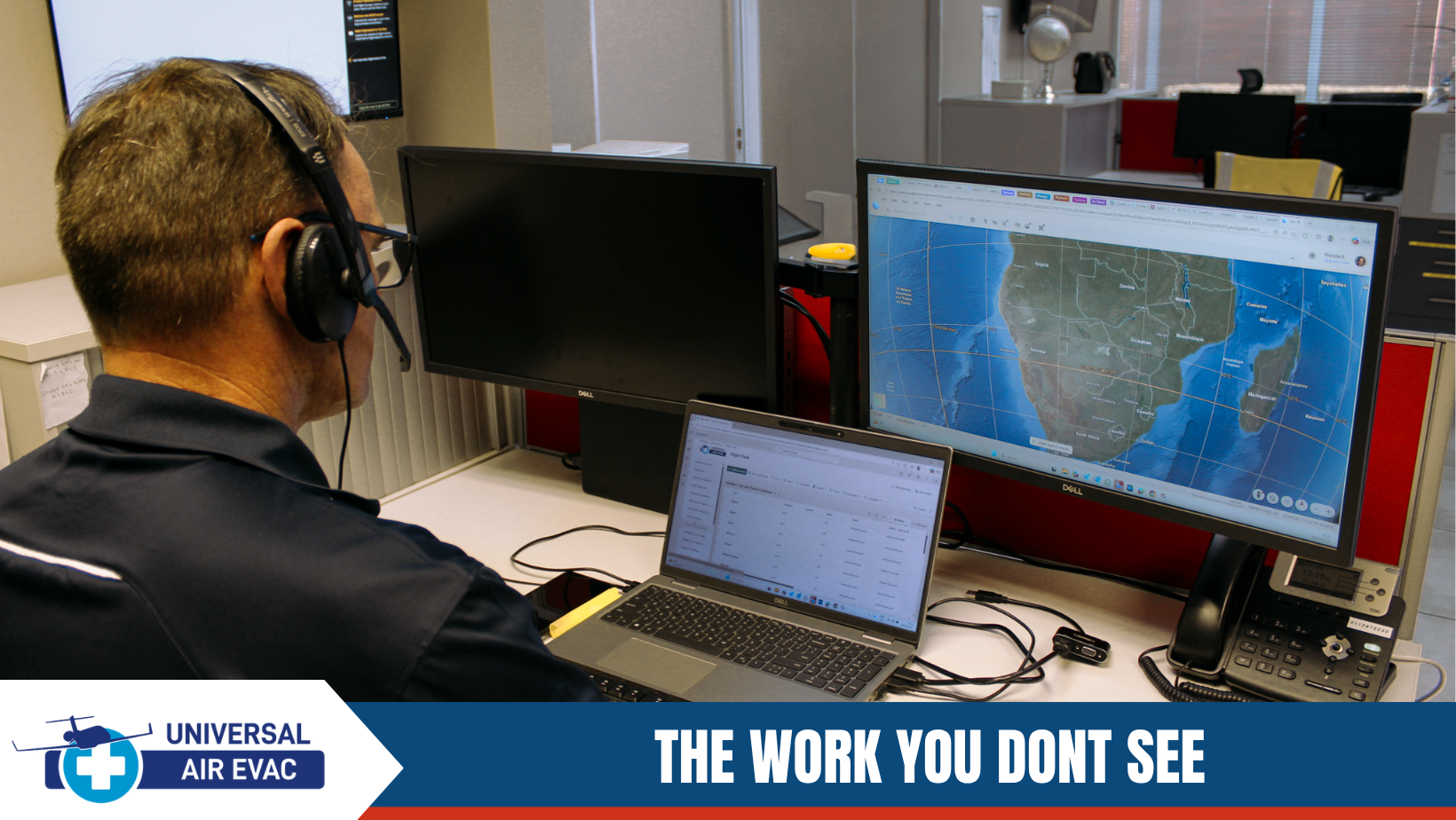
When most people picture an air ambulance mission, they see the aircraft, the medical equipment, and the clinical team caring for the patient in flight.
What they don’t necessarily see is everything happening behind the scenes.
A medical evacuation involves multiple people, organisations, and logistical requirements, often across different cities or countries. Hospitals need to communicate. Medical information must be assessed. Aircraft and crews need to be coordinated. Ground ambulances may need to be arranged at both ends of the journey. Documentation, airport requirements, and patient-specific medical needs all have to be considered.
Bringing these elements together requires careful case management.
During Case Management Week, we look at the work that happens away from the aircraft and why effective coordination between the entire team is such an important part of a medical evacuation.
It Starts With Understanding the Patient
Every medical evacuation begins with a patient, not a flight.
Before an appropriate mission can be planned, the team needs to understand the patient’s condition, current treatment, clinical stability, and the level of care that may be required during transport.
A stable patient requiring monitoring will have very different needs from a critically ill patient requiring ventilation, continuous intervention, specialised medication, blood products, or other advanced medical support.
Certain conditions can also affect how the flight itself needs to be planned. A patient may require a sea-level cabin, for example, or specific arrangements may be necessary for an infectious disease transfer.
This initial assessment helps determine the appropriate medical team, equipment, aircraft requirements, and operational considerations for the mission.
Connecting the Medical Teams
An air ambulance transfer rarely involves only one medical team.
There may be doctors and nurses at the sending hospital, the air ambulance medical crew, ground ambulance teams, and clinicians at the receiving facility.
Effective case management helps connect these different parties so that important information follows the patient throughout the journey.
Before departure, the air ambulance team needs access to relevant medical information and an understanding of the patient's current condition. At the destination, the receiving facility needs to be prepared for the patient's arrival and ongoing care.
The objective is to create continuity throughout the transfer rather than treating each stage as an isolated part of the journey.
Coordinating the Journey Around the Patient
Once the medical requirements have been established, the operational planning begins.
Depending on the mission, this can involve coordinating:
- Aircraft and crew availability
- Flight planning, routing and clearances
- Airport permissions, fuel and operating hours
- Ground ambulance transfers
- Hospital admission and discharge arrangements
- Medical documentation
- Passports, visas, and other travel requirements
- Specialist medical equipment and medication
- Communication between the sending and receiving facilities
These arrangements often need to happen simultaneously, particularly when a medical evacuation is urgent.
Timing can introduce additional considerations. If a mission needs to operate outside an airport’s normal operating hours, for example, arrangements may need to be made to keep the airport open, which can affect both logistics and costs.
Weather, airport restrictions, aircraft range, patient condition, and destination requirements can also influence the final mission plan.
Managing the Details Patients and Families May Never See
For patients and their families, a medical evacuation can be an unfamiliar and stressful experience. They may be dealing with a serious illness or injury while also trying to understand how someone will be transported, where they are going, and what happens next.
Much of the coordination required to make that journey possible happens out of sight.
A well-managed case means the various parties involved know what is required of them and when. Information is shared with the relevant teams, arrangements are confirmed, and potential complications are identified as early as possible.
While patients and families may never see every phone call, document, operational decision, or clinical discussion involved, each forms part of the overall mission.
From Bedside to Bedside
A medical evacuation does not simply begin when the aircraft takes off or end when it lands.
The complete journey may start at a hospital bedside, continue by ground ambulance to the airport, transition to the air ambulance, and then continue through another ground transfer to the receiving facility.
Each handover matters.
Good case management helps ensure that the different stages connect effectively, with the patient’s medical requirements remaining central throughout.
This is why the concept of bedside-to-bedside care is so important in medical evacuation. The aircraft may be at the centre of the journey, but it is only one part of a much larger continuum of care.
The Human Side of Coordination
Behind the schedules, flight plans, medical reports, and logistics is something much more important: a person who needs to get safely from one place of care to another.
Case management brings together the clinical and operational sides of a medical evacuation while keeping that patient at the centre of the process.
It requires communication, attention to detail, adaptability, and close coordination between people who may be working across different organisations, healthcare systems, countries, and time zones.
When that coordination works well, much of it may go unnoticed.
And that is often the point.
Recognising the Work Behind Every Mission
Case Management Week provides an opportunity to recognise the people responsible for managing the many details behind complex patient journeys.
At Universal Air Evac, every mission involves more than getting an aircraft into the air. From the first enquiry and medical assessment through mission planning, hospital coordination, flight operations, patient transport, and final handover, there is an entire team working behind the scenes.
Because a successful medical evacuation is not simply about moving a patient.
It is about coordinating the right care, people, equipment, and logistics to help move that patient safely from where they are to where they need to be.